Installation
Motorhome roof antenna for 4G and 5G: choosing, fitting and cabling
A good roof antenna is often the biggest single upgrade for internet in a motorhome. Here is when it is worth it, what to look for and how to fit it so it stays dry.
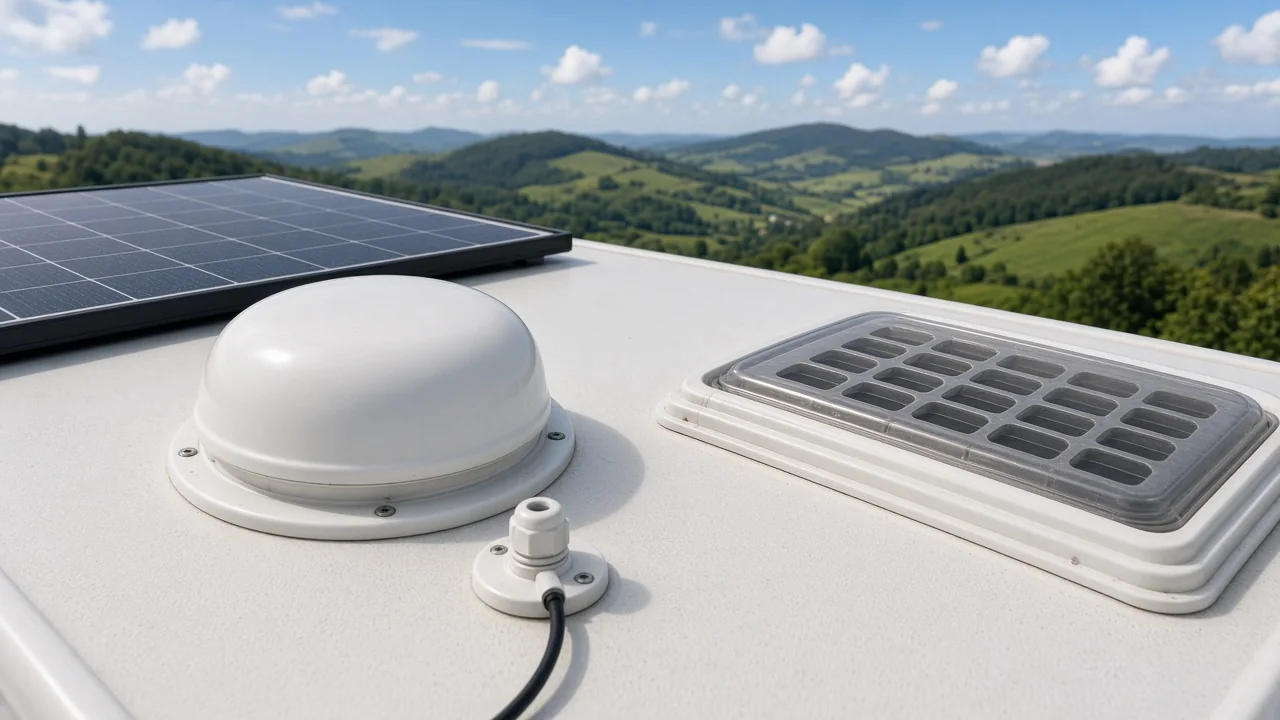
Inside a motorhome the router sits in a box. Aluminium skin, insulated walls, tinted windows and the people moving around inside all weaken the mobile signal before it reaches the router. On a campsite next to a town that hardly matters. In a valley, under trees or at a quiet spot far from the nearest mast, it is the difference between a video call and a frozen screen. An antenna on the roof moves the receiver outside the box and higher up, which is exactly what mobile signal likes.
When is a roof antenna worth it?
- You often park in the countryside, in mountains or by lakes rather than in towns.
- You work from the van and need a stable connection for calls.
- You stream in the evening and want the full speed of the network rather than whatever leaks through the wall.
- You have a fixed router installed, or plan to.
If you mostly stay on large campsites and use a portable router a few weeks a year, start by placing the router well. A self-adhesive window antenna can be a simple middle step.
What MIMO means and why the number of cables matters
Modern 4G and 5G routers use several antennas at the same time, called MIMO. A 4G router typically uses two antenna connections, many 5G routers use four. A roof antenna for 5G therefore usually has four mobile cables, sometimes plus WiFi and GPS cables. Connect every mobile cable to the matching port on the router. If you only connect one, you lose much of the speed the antenna could give you.
Before buying, check that your router has external antenna connectors, usually SMA, and how many. A roof antenna only helps a router that can be connected to it.
Cable length: shorter is better
Every metre of cable loses a little signal, and the loss grows at the higher frequencies 5G uses. Choose a low-loss cable and keep it as short as the route allows. In most motorhomes, with the router in an overhead locker near the antenna, five metres is plenty. In a large caravan or when the router sits at the far end, ten metres may be needed. Do not coil up spare cable behind a panel if a shorter one would do.
How to fit it so the roof stays dry
- Choose a spot with open sky around it, not right next to an air conditioner, a satellite dish or a tall roof box.
- Where possible, use an existing roof feed-through, for example the one used for solar panel cables, instead of drilling a new hole.
- If you drill, clean and degrease the surface, use a sealant made for vehicle roofs and seal the screws as well as the base.
- Run the cables inside along a wardrobe or a cable duct, without sharp bends, and leave a little slack at the router.
- Check the seal after the first long drive and once a season.
Not comfortable working on the roof? Most motorhome workshops can fit an antenna in an hour or two, often at the same time as a habitation service.
Omnidirectional or directional?
For a motorhome an omnidirectional antenna is almost always the right choice. It receives from all directions, so you do not need to aim it every time you park. Directional antennas can reach further, but they have to point at a mast you usually cannot see, which is impractical when you move every few days.
New to the subject? Start with our guide to WiFi in a motorhome, which explains how router, SIM and antenna work together.
Frequently asked questions
Does a roof antenna work with any router?
Only with routers that have external antenna connectors, usually SMA. Check how many ports your router has and connect every mobile cable from the antenna.
How much faster is it with a roof antenna?
It depends on the place. Close to a mast the difference can be small. In weak areas an outside antenna can turn an unusable connection into a stable one, because the vehicle body no longer blocks the signal.
Can I fit the antenna myself?
Yes, if you are used to working on the roof and use the right sealant. Using an existing cable feed-through avoids drilling. Otherwise a motorhome workshop can do it quickly.